NAVI // CHROMIUM
the browser is part of the OS.
On navi, the browser is not just an app. It is an application runtime, a policy surface, a visual layer, and eventually a platform we intend to shape ourselves. The web is navi's ideal app layer — portable, inspectable, offline-capable when we build it that way, and already understood by the tools people use every day.
The stack is already real: 72 shipped webapp launchers, a webapp CLI, managed policy, and optional browser installers. Ownership is the next step — and the point was never Chromium for its own sake. It's a stable web runtime navi can integrate deeply without taking choice away.
↓ take this page offline — the full report as a PDFSHIPPED · THE WEBAPP SYSTEM
navi turns the web into first-class desktop software
A navi webapp is not a bookmark. It is an installed desktop entry with its own icon, its own window, and the same launcher visibility as a native application.
The public CLI is navi-webapp — install, uninstall, list, doctor. The wrapper translates a stable user-facing command into the catalog backend; doctor checks launchers, icons, caches, and common install mistakes.
Why app mode matters: the service gets an independent window in the compositor. Rofi launches it by name and icon, not by URL. Task switching treats it as an application surface. And the underlying engine still receives Chromium policy, extensions, and security updates.
First-party front doors: navi radio, neighborli, glyyph, and the naviApps storefront make the strategy visible — the distro's own services arrive as web technology without feeling bolted on. Users add more from the 72-launcher catalog. The default install is curated rather than exhaustive; the wider catalog stays available on demand. Telegram and Element have moved toward native-app paths, which shows navi treats the web layer as a strong default mechanism rather than a dogma.
local-first engineering keeps the app layer dependable
navi's web stack includes pages that never need to become public internet services. A local page should work as a local page — including when Chromium is already running.
The failure that shaped the design: the naviApps storefront originally read its catalog with fetch(). Under file://, that required a file-access flag — and Chromium can ignore new command-line flags when an existing browser process handles the request. So the store could fail in the most ordinary case: the browser was already open.
The fix was architectural, not another launch flag. apps.json remains the source of truth, but build-catalog.sh emits an inlined catalog.js. The local page loads that data directly and no longer depends on file-origin fetch behavior.
Design rules that fell out of it:
- Offline-first means no hidden server. Local tools must work from the filesystem.
- Existing browser state counts. A clean-launch test is not enough.
- Flags are part of the runtime contract. All 72 launcher files currently carry both
--appand--force-dark-mode. - Generated data must ship with its source. Catalog changes update both
apps.jsonandcatalog.js.
Deterministic dark mode: Chromium's system-theme detection can be unreliable on sway when the desktop portal isn't answering. navi puts a wrapper at /usr/local/bin/chromium that calls Debian's browser with --force-dark-mode, and a generated desktop override routes menu launches through that wrapper without modifying Debian's packaged file. User control remains: because navi's flag comes first, an explicit later --force-light-mode can override it. A curated default is not the same as a lock.
SHIPPED · POLICY MANAGEMENT
policy makes the baseline coherent across profiles
navi uses Chromium's managed policy layer to install a small, explicit set of browser components. The result is reproducible: a new profile still looks and behaves like navi.
- nightshadeNeon — the browser theme arrives on first launch and stays present while policy applies. Deployed.
- uBlock Origin Lite — the current policy-level blocker. blackice has not replaced it yet. Deployed.
- Proton Pass — the stable extension is pinned as part of the baseline. Deployed.
The policy is stored as JSON under /etc/chromium/policies/managed/ and uses Chromium's ExtensionInstallForcelist. Force-installed items are installed silently and cannot be disabled or removed by the user while the policy remains in effect.
What this buys: coherence — theme and security defaults don't depend on profile sync. Privacy by default — blocking is present before anyone shops for an extension. Supportability — bug reports begin from a known baseline. Recovery — the baseline is reconstructed by redeployment, not by profile surgery.
What this obligates: keep the list small — a non-removable default carries more responsibility than a recommendation. Pin stable channels only; no beta surprises. State ownership honestly: uBOL is upstream's, blackice is a fork, Proton Pass is Proton's. Test browser coverage, because policy directories differ across Chromium-family packages. Coherence is useful only when the user can understand what's being enforced and why.
↑ back to topTHE BROWSER LINEUP
one runtime contract, several browser choices
navi can be opinionated about the integration layer without pretending there is one correct browser for everyone.
- Chromium — the default today. Debian's Chromium is the known baseline. navi's wrapper, launcher overrides, app windows, and policy are designed around it and exercised by the default install.
- Helium — dogfooding. An open-source Chromium browser maintained by imput, based on ungoogled-chromium, shipped with its own Linux packaging. Raven runs it as a daily driver while navi evaluates it as the likely base for accela. The questions are practical: security-update lag across releases, package behavior on navi, and whether the divergence list stays short.
- Microsoft Edge — a candidate option. Being evaluated as a user choice, not a default. Its Linux build looks at home under nightshadeNeon and its performance controls are unusually granular. Its telemetry model doesn't match navi's zero-telemetry direction, so that tradeoff belongs in the recommendation rather than in fine print.
- Brave — loved, not just listed. Brave is the rare Chromium browser that treats privacy as the product: built-in ad and tracker blocking, fingerprinting resistance, no account required. It arrives already aligned with navi's direction instead of needing navi's policy layer to fix it first. Brave Nightly is in navi-extras for anyone who wants it as a daily driver.
- Google Chrome — the reference build. When something renders oddly in a fork, Chrome is the control experiment: stock Chromium plus Google's services, straight from Google's own repository. Its telemetry model is Google's, which is exactly why it's a choice here and never the default. In navi-extras for anyone who needs the real thing.
- Yandex Browser — the new arrival. The newest addition to navi-extras, with its own take on the Chromium experience. Early days: the installer just landed, so this bullet grows up as we learn how it behaves on navi. Choice means choice — good tech is good tech, wherever it's from.
- One menu, no surprises. Chromium ships with the system; every browser above it installs through navi-extras. Installer scripts live under
scripts/installers/, deploy to/usr/share/navi/installers/, and are never run by the main installer. One optional browser failure must not endanger the operating-system install.
Shipped: the browser picker. navi-browser detects installed Chromium-family browsers, runs a headless launch smoke test, and sets one canonical default in ~/.config/navi/default-browser. Webapp launchers resolve that setting at launch time instead of hardcoding chromium — choose Brave and every webapp runs under brave-browser --app. Switching browsers also offers to deploy navi's managed policy (theme, uBlock Origin Lite, Proton Pass) to the new browser's policy directory, which the picker locates by probing each browser binary for its compiled-in policy path. The scope stays Chromium-based because app mode and managed-policy behavior are the contract navi can support consistently. Choice preserved, integration tested.
MICROSOFT EDGE ON NAVI
edge has a real efficiency case — and visible linux debt
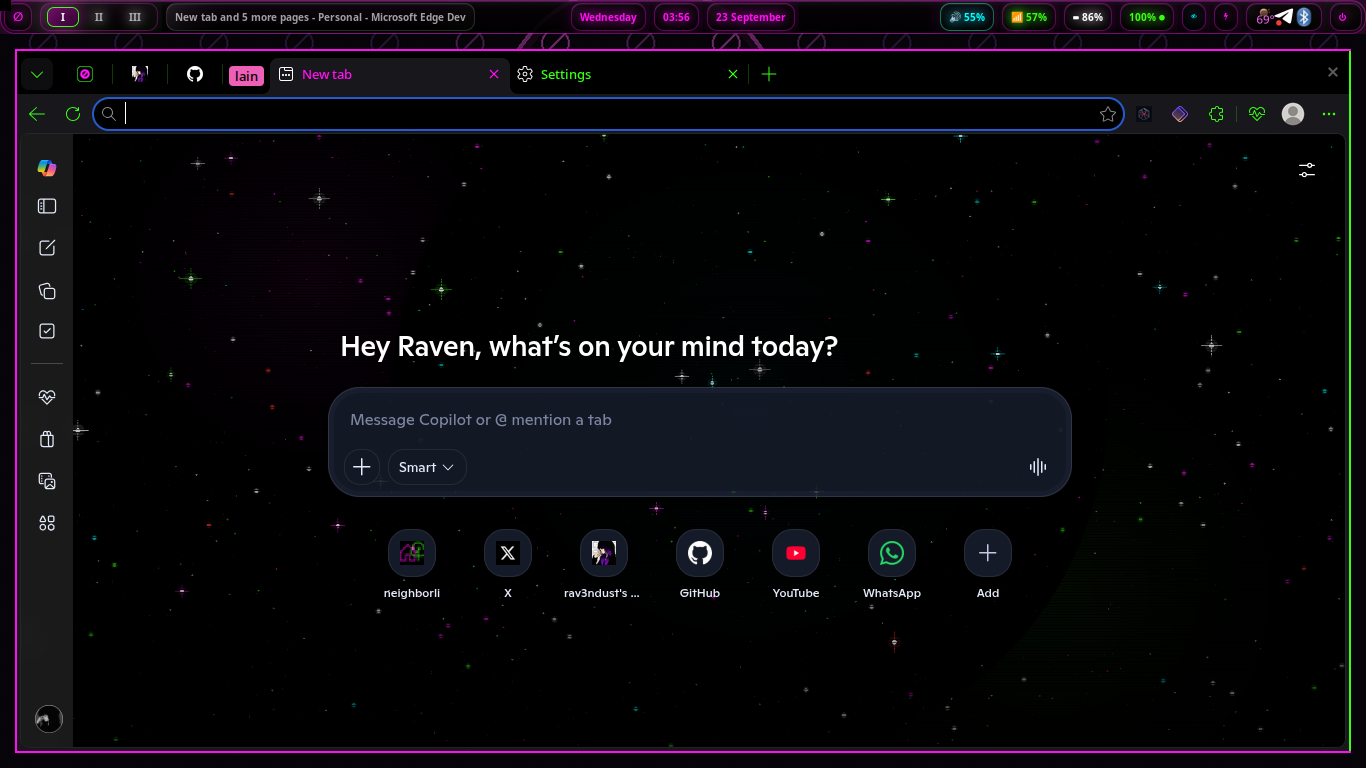
Why it's worth supporting: Edge exposes sleeping-tab controls that put inactive tabs to sleep, let users choose the inactivity interval, and allow exceptions. Microsoft describes the feature as a way to reduce memory and CPU use. That is not a benchmark claim for navi hardware — it is a product capability with obvious relevance to low-power systems and machines with limited memory.
Why it's not the default: navi's direction is zero telemetry. Edge's product and account stack makes it a tradeoff rather than a clean philosophical fit. The honest position is stronger: users who value Edge's workflow or efficiency controls should be able to choose it, while navi states clearly why it remains optional.
The integration bar: visual fit is necessary but not sufficient. A browser option also needs dependable Linux window behavior, working first-party controls, predictable updates, policy compatibility, and app-mode launches that survive real daily use.
↑ back to topUPSTREAM CITIZENSHIP
integration includes trying to make upstream linux support better
navi's first response to a browser bug should not always be a distro-only patch. When the failure belongs upstream, the useful work is evidence, a clear report, and verification when a fix lands.
| tracker id | observed behavior | state |
|---|---|---|
| EDGE-LINUX-001 | The Copilot toolbar button does not function on the tested Linux build. | Open; awaiting response |
| EDGE-LINUX-002 | Enabling "Use system title bar and borders" produces no change; Edge's custom chrome remains in place. | Open; awaiting response |
23 September 2026 — evidence sent upstream. Raven submitted both issues through Edge's built-in feedback system with a screenshot, a screen recording, and a detailed write-up, identifying himself as a navi maintainer who wants Edge to be a reliable distro option.
Now: a public record is maintained — docs/edge-linux-feedback.md keeps the issue IDs, exact behavior, submission history, and current status in one place. Both issues are also tracked with their status on our issues page, alongside every other bug we know about — ours and upstream's.
When fixed: verify on navi. The tracker calls for testing on eiri's Debian trixie base, against Edge Dev and Stable, on real navi hardware. A vendor response is not the same as a verified fix.
A distro maintainer lobbying Microsoft for better Linux support is unusual leverage. It should be spent deliberately: reproducible behavior, visual evidence, one public status page, no inflated claims. A private patch shifts maintenance onto navi and hides the Linux problem from everyone else; an upstream repair improves Edge for other distributions too. The same principle applies to Helium — dogfood is due diligence. Daily use is how update lag, policy gaps, regressions, and browser-specific assumptions become visible before accela inherits them.
↑ back to topDOGFOODING · PRIVACY LAYER
blackice moves blocking from a chosen extension toward owned infrastructure
The transition is staged on purpose. navi should replace a proven blocker only when its own fork has earned the job. uBlock Origin Lite is still the force-installed policy blocker today; blackice is dogfooding now; only after testing does the policy ID change.
What blackice is: xvoidsx's GPLv3 fork of uBlock Origin Lite — a Manifest V3 ad and tracker blocker with a nightshadeNeon interface. The blocking engine, filter-list machinery, and Declarative Net Request conversion remain upstream work. Raymond Hill's copyright and the uBlock Origin contributors' notices stay intact; xvoidsx adds its copyright only to its own interface, branding, defaults, and genuine curated-list work.
Boundaries that protect credibility: never present blackice as an official uBlock project. Never dogfood it beside uBO or uBOL — overlapping blockers fight over the same requests. Never show fake statistics, controls, or placeholder lists. Keep the Chromium build as the supported target — no other target gets claimed until it’s packaged and tested. Change the navi policy only after the dogfood gate passes.
One brand, two engines: the extension is the portable phase — it can run in Chromium-family browsers now and build recognition around one privacy surface. The native accela phase is different work: an adblock-rust component sits closer to the browser and avoids making the extension the permanent architectural ceiling. The name and user experience stay continuous even as the engine changes.
↑ back to topDOGFOODING · ACCELA FOUNDATION
helium is the practical starting point, not a dependency of faith
Forking raw ungoogled-chromium would maximize control on day one and maximize release-engineering burden at exactly the same time. Helium changes that equation: productized Linux packaging, update paths, services, and cross-platform work already exist in public repositories — and it's based on ungoogled-chromium rather than stock Google Chrome, with Helium-specific work published under GPL-3.0. accela can aim to remain a legible patch set instead of becoming an opaque Chromium tree.
What navi must watch: security-update lag — dogfood across several Chromium releases, not one good week. Divergence — record every "Helium chose X; accela would choose Y" decision. Ad blocking — Helium's baked-in uBlock component and blackice are the clearest known overlap. Linux integration — policy directories, app mode, theming, codecs, and window behavior need target-system tests.
The escape hatch is part of the design. If Helium's direction or cadence stops fitting, a clean accela patch stack should be portable back toward plain ungoogled-chromium. A base is useful when it reduces work without becoming a trap. Helium's own README describes it as beta — that makes Raven's daily-driver period a precondition, not a ceremonial trial: normal browsing, updates, extensions, app windows, and navi policy all need time to fail honestly.
↑ back to topTHE HORIZON · ACCELA PRODUCT LAYER
the goal is a navi-native browser, not a logo swap
accela is where the browser becomes an owned interface to the wired: visual identity, privacy, search, agents, and the smallweb designed as one system.

- Smallweb built in — gemini and other smallweb paths become first-class navigation, not specialist afterthoughts.
- Zero telemetry — no analytics or product surveillance added by xvoidsx; privacy is an architecture constraint.
- Native blackice — adblock-rust moves blocking into the browser while the extension remains the portable phase.
- Hey Lain — local and cloud agent support replaces the generic "AI Mode" story with a navi-native assistant surface.
- Private search — a privacy-respecting search layer with a smallweb-scoped index as the long-term wedge.
- Native bangs —
!radio,!nl,!apps,!wiredturn the address bar into a map of navi's own front doors.
"Wallpaper is the theme": Chromium's native color extraction can use a new-tab-page wallpaper to tint the wider browser chrome. In Raven's navi tests, pulsegrid, katakana rain, and jellyfish each produced coherent palettes without the muddy mappings seen with an external theme. That suggests a stronger accela model: the selected navi gifpaper becomes the browser's visual source of truth. Leading default: pulsegrid — the boldest statement of the navi visual language, static frame on older hardware, animation as an explicit option. Showcase alternative: jellyfish — a softer pink-purple-plum palette proving the same system can change mood without losing coherence.
The default new-tab shortcuts should point to navi's front doors — neighborli, navi radio, glyyph, naviApps, and the navi site — rather than one maintainer's personal history. Personalization begins from a useful public baseline.
↑ back to topROADMAP AND GUARDRAILS
own more of the layer without outrunning the proof
The sequence matters. navi can deepen Chromium integration now while keeping accela on the horizon rather than turning it into the next-release bottleneck.
- Now — harden the shipped contract. Keep Chromium, the 72 app launchers, local catalog behavior, deterministic dark mode, and current policy supportable on real navi hardware.
- Next — make browser choice explicit. Build the settings TUI, a canonical browser setting, detection, app-mode tests, and clear fallback behavior.
- In parallel — dogfood and push upstream. Measure Helium's update cadence; track Edge Linux issues; verify vendor fixes instead of closing them on response alone.
- After proof — graduate blackice. Replace the uBOL policy entry only after the extension survives normal use and the packaging path is ready.
- Later — begin accela in sequence. The roadmap places it after the desktop navi launch, navidroid, and eiri work: a strategic horizon, not the next checkbox.
Non-negotiable principles: additive, not purist — a strong default doesn't require purging alternatives. Choice preserved — users choose the browser while navi owns the compatibility contract. Zero telemetry — xvoidsx-owned layers collect nothing by default. Open models, open web — agent features should widen the web rather than trap it inside one provider.
Scope boundaries: Safari is explicitly out of scope. Edge remains optional even if its Linux bugs are fixed. Helium remains a candidate base until dogfood evidence is strong enough. accela should not claim integrations before they exist.
Choice does not come from refusing to make decisions. It comes from making the integration legible, keeping alternatives available, and separating what ships from what is merely planned.
↑ back to topCLOSING / REFERENCE
the browser is the user's agent on the web
navi treats that role as infrastructure worth understanding and, piece by piece, worth owning. Today's stack is deliberately practical: Debian Chromium, app-mode windows, local pages, Rofi launchers, managed extensions, and optional alternatives. Tomorrow's stack is more ambitious: a user-selectable Chromium runtime, blackice as an owned privacy layer, and accela as the browser where navi's visual, smallweb, search, casting, and agent ideas meet.
The continuity matters more than the brand name. navi is not waiting for accela to begin integrating the browser well, and it is not using today's Chromium dependence as an excuse to avoid owning tomorrow's design.
wired/scripts/naviwebapp.sh— public webapp CLIwired/naviApps/— catalog, launchers, icons, local storewired/chromium/— policy and dark-mode wrapperscripts/installers/— optional browser installersdocs/edge-linux-feedback.md— public Edge issue tracker
github.com/xvoidsx/navi · github.com/xvoidsx/blackice · the full report as a PDF
Sources
- xvoidsx/navi — repository and eiri working tree.
- naviApps local-catalog commit — why catalog data is inlined.
- Chrome Enterprise policy reference — force-installed extension behavior.
- imputnet/helium and helium-linux — project, licensing, and Linux packaging.
- Microsoft Edge performance features — sleeping tabs and configuration.
- navi Edge-on-Linux feedback tracker — issue details and submission log.
- xvoidsx/blackice — scope, attribution, license, and supported target.
Status note: "shipped", "dogfooding", and "planned" describe project state as of 23 September 2026. Planned items are not presented as shipped features. — open models, open web